How to load an eSIM on a Teltonika router using the RutOS app and your phone’s data
Load an eSIM profile onto a Teltonika RUT241, RUTM52 or ATRM50 with no internet on site, using the RutOS app and your...
The plain-English field guide to UK 5G networks, SIMs and eSIMs
Standalone or non-standalone. Consumer, business or IoT. One network, several, or roaming in from abroad. The 5G icon on your screen hides a lot of detail, and that detail decides whether your phone, router or sensor actually performs. This site explains it in plain English.
Operator-reported population coverage at the dates shown. Ofcom put outdoor standalone coverage at 49% to 85% across the three standalone networks in spring 2026.
Plans built for people: big data allowances, handset deals, fair use policies and the occasional tethering limit.
Pooled data, static IPs, private APNs, service levels and someone to ring when it breaks. Standalone and slicing start to matter here.
Low data, long life, no human to press a button. Multi-network SIMs, eSIM profiles and the 2G switch-off decide more than headline speed.
The UK has three 5G network operators since VodafoneThree. How EE, O2 and VodafoneThree compare on 5G standalone, spectrum and who can use it, checked...
The big onePlain-English guide to 5G SA vs NSA: what the 5G core changes, what it does for phones, routers and IoT, and how to check which one your device is rea...
5G SIMsWhat a 5G SIM card actually is, whether your old SIM works with 5G and 5G standalone, and how to choose a 5G SIM for a phone, a router or an IoT devic...
Three worldsWhy a consumer 5G SIM, a business 5G SIM and an IoT SIM behave differently on the same UK network: data, priority, IP addressing, APNs, roaming, suppo...
BusinessHow UK businesses actually use 5G: backup for broadband, primary connectivity for sites without fibre, temporary sites and vehicles. Static IPs, priva...
IoTWhich cellular technology an IoT device really needs in the UK: LTE-M, NB-IoT, 4G Cat 1, 5G RedCap or full 5G. How 5G standalone, roaming and eSIM aff...
RoamingHow 5G roaming works for UK SIMs abroad and for foreign and IoT roaming SIMs in the UK: 5G NSA vs SA roaming, permanent roaming restrictions, steering...
ResilienceHow multi-network and multi-IMSI SIMs connect to more than one UK network, steered vs non-steered, how fast failover really is, and whether you get 5G...
eSIMHow eSIM works with 5G for phones, routers and IoT devices. The difference between consumer eSIM (SGP.22), older M2M eSIM (SGP.02) and the new IoT sta...
eSIMWhat a 5G eSIM router is, how eSIM profiles get onto it, the difference between consumer and IoT eSIM in routers, and the questions to ask before buyi...
PracticalHow to check UK 5G and 5G standalone coverage for a real location, why coverage maps disagree, and what RSRP, RSRQ and SINR mean when you are placing...
LegacyUK 3G has gone and 2G will follow by 2033. Network-by-network status, what it means for alarms, meters, trackers and roaming IoT devices, and how to p...
Load an eSIM profile onto a Teltonika RUT241, RUTM52 or ATRM50 with no internet on site, using the RutOS app and your...
Temporary internet connectivity used to mean a BT engineer, a six-week lead time, and a contract you couldn’t get out of. That...
Teltonika routers are everywhere in UK industrial and IoT work, and they are sold by a lot of people: specialist distributors, general...
Teltonika RMS has quietly become one of the most influential tools in the entire industrial IoT ecosystem. Anyone deploying fleets of routers,...
Most industrial deployments do not need a full 5G router. They need something small, reliable and cheap enough to fit in every...
5G is redefining industrial and IoT communication. It’s faster, lower-latency, and more reliable than any mobile technology before it. But achieving dependable,...
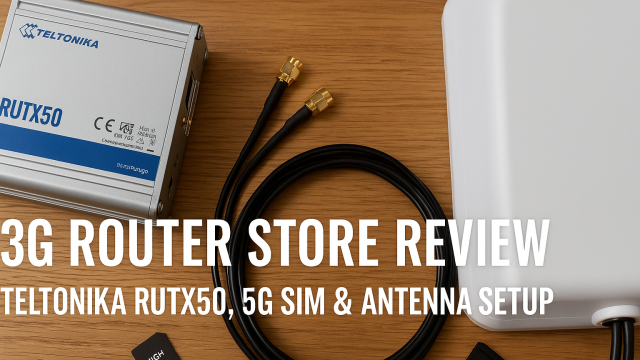
The RUTX50 has been Teltonika's workhorse 5G router for a few years now, and it is still the one I would point...
Connectivity is constantly pushing boundaries, and nowhere is that more apparent than in demanding environments like the railway industry. Operators need to...
Teltonika Industrial Ethernet Switch Selector Guide Teltonika offers a versatile range of industrial Ethernet switches designed for reliable, high-speed connectivity in harsh...
A 5G SIM is a SIM or eSIM profile that the network has enabled for 5G service. The plastic is usually the same as a 4G SIM; what changes is the profile on it and the plan behind it. For 5G standalone some UK networks also need a newer SIM or an eSIM, so an old SIM can be the reason a 5G device never shows standalone.
Non-standalone 5G (NSA) adds 5G radio to a connection that is still controlled by the 4G core network. Standalone 5G (SA) uses a dedicated 5G core, which is what enables lower latency, network slicing, RedCap devices and voice over 5G. EE and O2 market standalone as 5G+, Vodafone as 5G Ultra.
Usually, but not always. Consumer plans can carry fair use or tethering limits, some business and IoT SIMs are restricted to 4G or to non-standalone 5G, and multi-network or roaming SIMs often get 4G only. Check the plan, the APN and whether the router supports the UK bands, especially n78 and n28.
Sometimes. Inbound roaming on 5G non-standalone is increasingly common, but 5G standalone roaming is still rare. Many multi-network IoT SIMs connect at 4G in the UK, which is fine for most telemetry but not for high-throughput or low-latency work.